
Most carbon buried in South African seagrass meadows does not come from seagrass
In the fight against climate change, seagrasses are powerful underwater gardens, capturing carbon dioxide and locking carbon into coastal sediments, much like forests do on land. But when Stellenbosch University student Robyn van Zijl analysed the sediments in seagrass meadows in South Africa’s Berg River Estuary, she found that much of the carbon buried beneath them came not from the seagrass itself, but from the surrounding salt-marsh plants and even ocean kelp transported into the estuary.
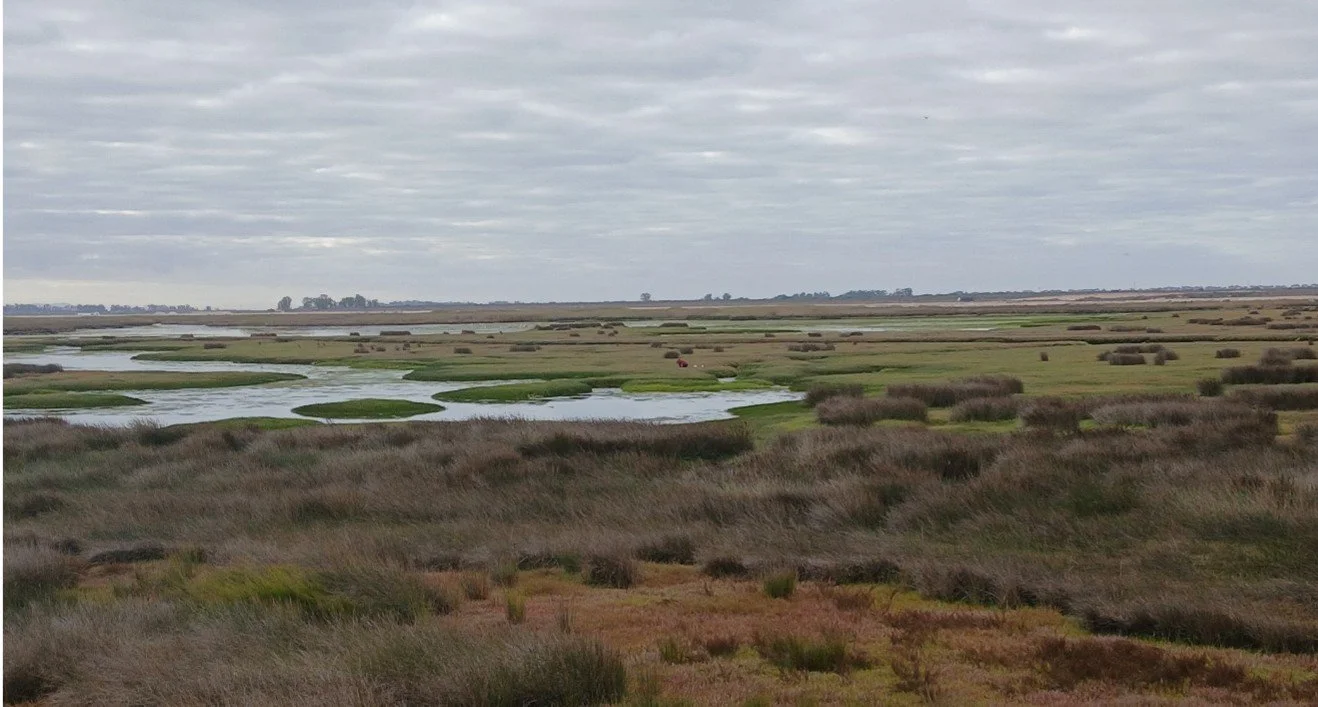
Salt marshes at the Berg River Estuary. Photo: Andrew Ndhlovu
Coastal vegetation, such as seagrass, salt marshes and mangroves, are called blue carbon ecosystems due to their connection to the ocean and their similarity to terrestrial forests, known as green carbon, and have been recognised for their role in capturing carbon dioxide and storing carbon. Despite covering only a small fraction (about 0.1%) of the ocean floor, seagrass meadows make an outsized contribution to ocean carbon burial. Among their many other benefits, they provide nursery grounds for fish, protect coastal areas from erosion and improve water quality.
The Cape dwarf-eelgrass (Zostera capensis) is South Africa’s most widespread seagrass, grows mainly in the shallow intertidal waters of estuaries and may be exposed at low tide. It is classified as Endangered because of habitat loss and degradation caused by coastal development, dredging, declining water quality and disturbances such as bait digging, trampling and boating.
Where does the carbon in seagrass come from?
In line with global trends, scientists in South Africa have been studying how much carbon is stored in the seagrass meadows of Z. capensis. However, one important question remains: Where does this stored carbon come from?
Some of this carbon is produced by the seagrass itself, while the rest may come from neighbouring vegetation and be transported by floods, runoff and tides before becoming trapped in the meadow. If this imported carbon is attributed to more than one ecosystem, the same climate benefit could be double counted. Knowing where the carbon comes from is therefore essential for accurate carbon accounting and for identifying which connected habitats need to be protected together.
Tracking the carbon source using its isotopic fingerprints
Researchers can trace where carbon buried in seagrass sediments comes from by analysing the stable isotopes of carbon and nitrogen, specifically the ratios of 13C/12C and 15N/14N. These isotopic fingerprints differ between plants and macroalgae like kelp, allowing researchers to identify the origin of sources of the stored carbon.
Robyn van Zijl, an honours graduate from Stellenbosch University’s Department of Botany and Zoology, wanted to understand how much seagrass and the surrounding vegetation and kelp contribute to buried carbon. The Berg River Estuary on the west coast contains some of South Africa’s largest seagrass meadows, making it an ideal natural laboratory for tracing carbon sources. Robyn collected sediment samples from shallow layers, 0–2 cm below the surface, and deeper layers, 28–30 cm below the surface.
She also sampled both the centres and edges of the seagrass meadows. In addition to the sediment, she collected samples from 16 potential carbon sources. These included the seagrass itself, as well as salt-marsh plants, reeds and shrubs growing in and around the estuary. She also sampled the canopy-forming kelp, Ecklonia maxima, which grows in the ocean outside the estuary, but can be transported into the estuary. By comparing the isotopic fingerprints of these potential sources with those found in the shallow and deep seagrass sediments, Robyn was able to estimate how much carbon each source contributed to seagrass sediment.
The chemical fingerprint analysis revealed that 91-96% of the carbon buried beneath the seagrass meadows came from other sources, while the seagrass itself contributed only 4-9%. Salt-marsh plants were the largest source, supplying 43-53%, followed by macroalgae at 23-40%. Remarkably, kelp contributed as much as 35% at some sites with its carbon fingerprint detected more than 10 km upstream. The mix of carbon sources remained similar across sediment depths and between the centres and edges of the meadows. However, meadows with denser seagrass cover and finer, muddier sediments stored more organic carbon.
Why these results matter: From a single habitat to connected landscapes
For carbon accounting, the origin of the carbon matters. Carbon inventories must distinguish between where carbon comes from and where it is stored to avoid counting the same climate benefit twice. Seagrasses still play a valuable role by trapping and burying carbon produced by other ecosystems.
The strong kelp signal in the seagrass sediments was particularly remarkable. It revealed a strong connection between the ocean and the estuary, highlighting the valuable role of seagrass meadows in burying and storing ocean-derived carbon and reinforcing their importance as natural climate solutions.
The management lesson is clear: protecting seagrass alone will not safeguard the processes that supply and store its carbon. This study shows that salt marshes, seagrass meadows and nearshore kelp forests form an interconnected carbon landscape. The broader message is simple: blue carbon does not respect habitat boundaries. Following its fingerprints can reveal the hidden connections that coastal conservation and management must take into account.
What is next?
Given the remarkable findings on the contribution of kelp to estuarine sediments, another honours student, Lourens Erasmus, is extending this research. The follow-up study is analysing three stable isotopes instead of two, by adding sulfur (34S/32S) to carbon and nitrogen. Lourens is replicating the work in the Berg River Estuary, with a stronger focus on kelp, while incorporating additional samples from another large estuary, the Olifants, to test the robustness of the results.
Future research will investigate how seasonal changes influence the transport and deposition of carbon in seagrass meadows. Repeating the study during the winter flood season and the dry summer season could reveal whether the relative contributions of different carbon sources vary through the year.
Robyn completed an Honours degree in Biodiversity and Ecology, graduating with distinction from Stellenbosch University, and is currently pursuing an Advanced Diploma in Sustainable Development at the same university.
Article by Dr Andrew Ndhlovu
Acknowledgements
Robyn’s honours project was supervised by Professor Sophie von der Heyden (Department of Botany and Zoology, Stellenbosch University) and Dr Andrew Ndhlovu (School for Climate Studies, Stellenbosch University), in collaboration with Dr Janine Colling (BIOGRIP, Stellenbosch University). This work was funded by the National Research Foundation Marine and Coastal Research and Sasol-NRF collaborative grant, awarded to Prof von der Heyden.