
Isotope Node at UCT launches under Dr Tara Edwards
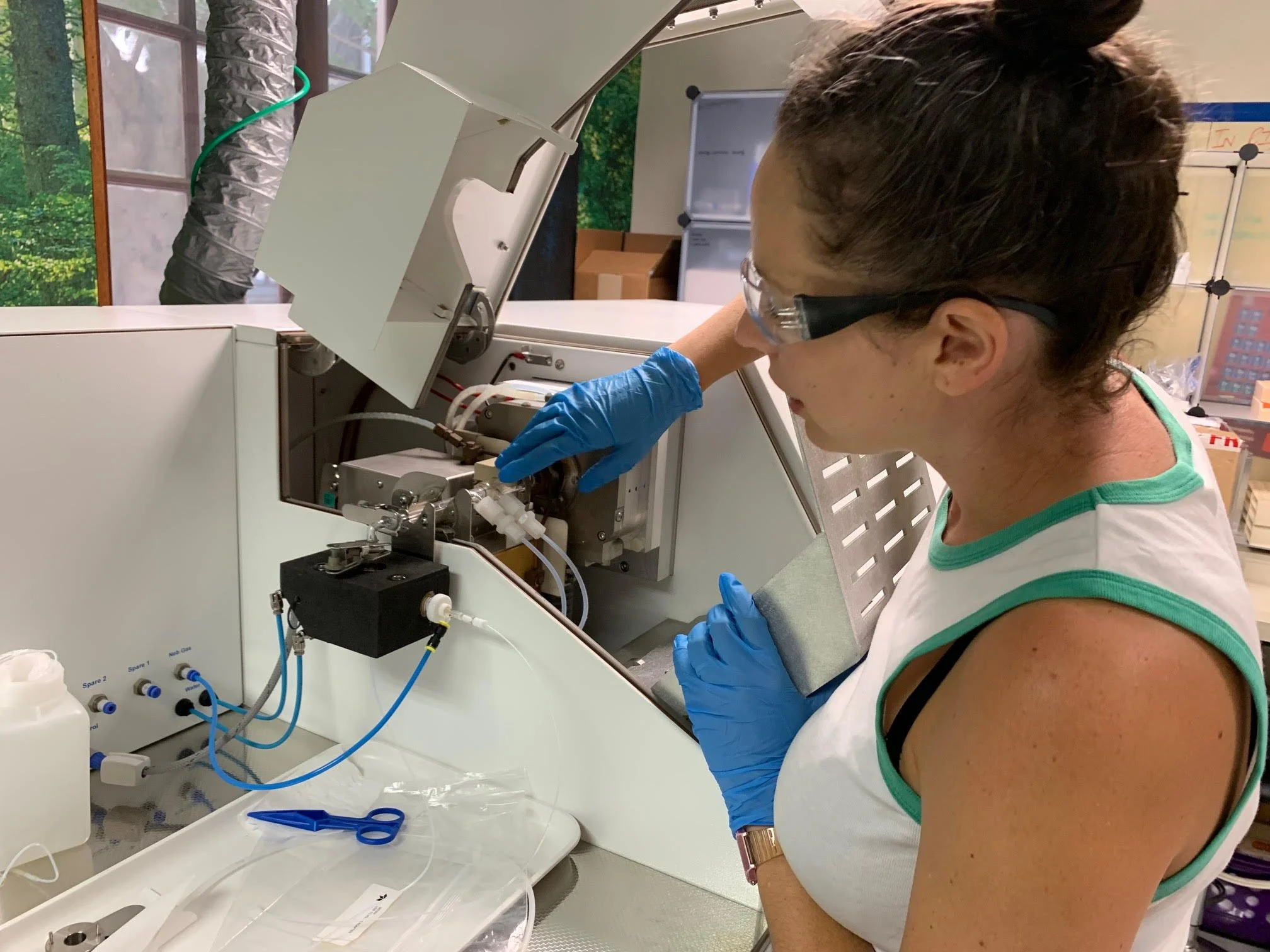
As Chief Scientific Officer in the new LA-ICPMS lab, Dr Tara Edwards will head up capacity with the RESOlution laser ablation system and Nu Instruments Attom - the first machine of its kind on the continent.
The Biogeochemistry Research Infrastructure Platform (BIOGRIP) has announced the appointment of Dr Tara Edwards as Chief Scientific Officer heading up the new lab housed at its Isotope Node of the new Laser Ablation and High-resolution Facility (LA-ICP-MS) Lab, housed at the University of Cape Town (UCT).
Launching the lab in January 2024, her vision is to develop an ecosystem of skills and capacity among local researchers who will manage and utilise its cutting-edge facilities for their own work and the work of others.
“I am honoured to take this position, and excited for the opportunity not only to develop and strengthen research capacity on the continent, but also to shift Africa to the forefront of isotope and geochemical analysis,” says Edwards.
Nicknamed the Lesolethu Lab, the facility’s name is a nod to the cutting edge analytical research capacity it makes available on the continent for the first time. In isiXhosa, ‘leso’ means ‘eye’, and ‘lethu’ means ‘for all of us’.
“We think Lesolethu is a fitting name for a national facility designed to ‘see’ into rocks and other important samples,” says Edwards.
Some of those samples will be connected to her own work. Indeed, Edwards takes the position after completing a PhD at La Trobe University in Melbourne, Australia. Her research focuses on geochronology and palaeoclimate reconstruction, with a special interest in the reconstruction and dating of speleothems from South Africa's Cradle of Humankind.
“Our focus right now is to provide researchers and post-graduate students with hands-on training to support the advanced skills necessary to operate instruments, conduct experiments, and to develop new analytical methods that until now were not available on the continent,” says Edwards.
Specifically, Uranium-lead dating will be central to the work coming out of the lab. Methodology which enables dating of materials like cave deposits, speleothems, stalagmites and flowstones. This research has important implications for human evolution, archaeology, and palaeontology.
The techniques made possible with the facilities available at the LA-ICPMS lab are also much less destructive, enabling laser precision that preserves the integrity of delicate samples.
“The kind of analysis Edwards will lead at this lab has until now only been possible by sending samples abroad,” says Dr Robyn Pickering, a geologist with UCT whose research relies heavily on the Uranium-lead dating enabled by the new facility.
“That gap in skills and knowledge will now be filled, paving the way for African researchers to participate in and lead these studies on their own and with their international counterparts.”